
The oil market in 2025 is at the center of international discussions, driven by one of the most significant surpluses in recent history, according to the report released by the International Energy Agency (IEA) on October 14.
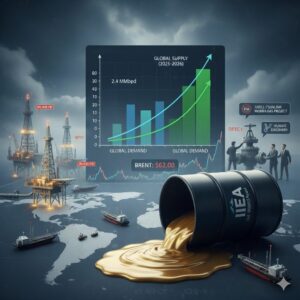
The global oil and gas industry is witnessing a changing landscape, marked by the rapid increase in supply relative to demand.
These factors are set to profoundly alter the balance among the producers, exporters and consumers involved in this ecosystem.
According to the IEA survey, global production is expected to grow by about 3 million barrels per day (bpd) in 2025, with an additional increase of 2.4 million bpd forecast for 2026.
This momentum is led mainly by the OPEC+ decision to unwind cuts and enable more aggressive production increases.
Heavyweights such as Saudi Arabia, Russia and the United States are adjusting their strategies to strengthen their international presence and preserve revenue, even in the face of prices that tend to remain below the levels seen in previous cycles.
Rising supply: The role of OPEC+ in the oil market in 2025
In addition to the repositioning of OPEC+, new projects and discoveries in the onshore and offshore sector reinforce the potential for additional production. Highlights include the approval by Shell and Sunlink of a new offshore gas venture in Nigeria, as well as major finds announced by Kuwait.
These moves further expand the sector's global pipeline, showing that the major players are alert to opportunities despite the pressured price environment. See details in Zawya's international coverage.
The proactive stance of OPEC+ in the oil market in 2025, combined with the progress of other producing countries, has been decisive for the increase in global inventories. On the other hand, the pace of consumption remains below expectations, requiring companies to be adaptable and more efficient in asset management.
Demand, inventories and prices in the oil market in 2025
The growth rate of global oil demand in 2025 is around 700 thousand bpd, a significantly smaller fraction compared with the increase in supply.
The IEA points to the main causes as the slowdown in economic activity, geopolitical tensions and the energy transition, which favors less carbon-intensive sources.
Developed countries show stable or slightly declining demand, while emerging markets try to offset part of the impact, without preventing inventories from rising in the world's main consuming regions.
As a result, international prices remain under pressure and volatile.
Brent, trading this Tuesday at around US$ 62 according to Trading Economics, reflects the new balance of the oil market in 2025, highlighting the direct impact of oversupply and market fluctuations.
The oil market in 2025 in Brazil: production, margins and strategies
Brazil is among the main global highlights, especially in the offshore segment. In August, national production reached 5.08 million boe/d, with the Búzios field taking the lead in volume produced. This position reinforces the country's competitiveness, but also calls for caution in light of the current global surplus scenario.
Brazilian exporters face price fluctuations and tighter margins, which intensifies the need for alternatives that ensure resilience in the face of international market instability. See official data on national oil production at the ANP.
The national industry, especially pre-salt companies, needs to step up productivity gains, adopt advanced extraction technology and maintain more competitive cost structures.
In the onshore segment, the lower price environment tends to postpone marginal expansions and FIDs, making asset selection even more rigorous.
How to face the oil market in 2025: strategies for the industry
Against this backdrop, Brazilian and international companies should focus their efforts on three essential areas:
Operational efficiency: Invest in automation, advanced extraction techniques and monitoring to ensure global competitiveness, reducing costs per barrel.
Risk management and hedging: Implement robust financial strategies to protect revenue against potential price drops and regional variations.
Sustainability and energy transition: Incorporate renewable alternatives into the portfolio and align operational practice with international environmental requirements.
These initiatives are essential to remain relevant in the oil market in 2025, even in a scenario of global oversupply and pressure for lower prices.
Conclusion: opportunities and challenges in the oil market in 2025
The IEA report makes it clear that the oil and gas sector will need to adapt to unprecedented surplus conditions and growing competitiveness demands. For Brazil and other major producers, the ability to innovate and increase production resilience will be decisive for success in the short and medium term.
Companies focused on technology, cost efficiency and sustainability will be able to turn challenges into opportunities in the oil market in 2025.
For consumers, the trend is toward more affordable prices and greater stability in energy supply.